Support our educational content for free when you purchase through links on our site. Learn more
How Do I Buy a Good Skateboard? 🛹

To answer “How do I buy a good skateboard?”, start with where you’ll ride and what you want to do, then choose a comfortable deck and components suited to that terrain. For many first-time riders, a well-matched complete skateboard from a reputable skate brand is the simplest way to get rolling without playing parts-compatibility roulette.
We’ve seen beginners pick boards by graphic alone, only to discover that tiny, hard wheels make their bumpy commute feel like a paint-shaker ride. The fix wasn’t a fancier logo; it was choosing a setup that matched the pavement.
The short version: check deck width and shape, make sure trucks fit the deck, choose wheels for your riding surface, and inspect the assembly. A local skate shop can help you compare boards in person, especially if you’re unsure what will feel right.
Key Takeaways
- Choose for your riding style: street and skatepark skating, cruising, and commuting can call for different skateboard setups.
- Start with fit: deck width, shape, and comfort matter more than choosing by height alone.
- Match the components: trucks should suit the deck, while wheel size and hardness should suit the ground you’ll ride.
- A complete can be a smart first board: check its brand, component details, assembly, and return policy.
- Inspect before riding: check bolts, wheels, grip tape, and deck condition—and wear a properly fitted helmet.
- Ask for help when needed: a skate shop can make sizing and component compatibility much less puzzling.
Table of Contents
- ⚡️ Quick Tips and Facts
- 🛹 Skateboard Buying Basics: What Makes a Good Board?
- Complete skateboard vs. custom setup
- Skateboard types: street, park, cruiser, and longboard
- 📜 A Brief History of Skateboard Design
- 🔎 10 Things to Check Before You Buy a Skateboard
- 1. Pick the right skateboard deck width
- 2. Match deck shape and length to your skating style
- 3. Check the deck’s construction and materials
- 4. Choose trucks that fit your deck
- 5. Select wheels for your terrain and riding style
- 6. Understand wheel hardness and diameter
- 7. Look for quality bearings
- 8. Check grip tape, hardware, and assembly
- 9. Make sure the board suits your experience and goals
- 10. Inspect the skateboard’s quality and safety
- 📏 Skateboard Size Guide: Deck Width by Height, Shoe Size, and Style
- 🛠️ Complete Skateboard vs. Custom Build: Which Should You Buy?
- 🏙️ Choose a Skateboard for Street, Skatepark, Cruising, or Comuting
- 🧩 Skateboard Setup Compatibility: Decks, Trucks, Wheels, and Bearings
- 🏷️ How to Compare Skateboard Brands and Components
- 🛒 Where to Buy a Good Skateboard
- Local skate shop, online retailer, or big-box store?
- How to evaluate a skateboard listing online
- New vs. used skateboards: what to inspect
- 💵 How Much Should You Spend on a Skateboard?
- 🪖 Skateboard Safety Gear and First-Ride Checks
- ❌ Common Skateboard Buying Mistakes to Avoid
- 🔧 Skateboard Maintenance: Keep Your New Board Rolling
- Conclusion
- Recommended Links
- FAQ
- How do I know if a skateboard is good quality?
- What size skateboard should I buy as a beginner?
- Is a complete skateboard good for beginners?
- Can I buy a skateboard at a department store?
- Are wider skateboards easier to ride?
- Should I buy a skateboard online or at a skate shop?
- What skateboard wheels are best for rough roads?
- How can I tell if a used skateboard is safe?
- Reference Links
⚡️ Quick Tips and Facts
Shopping for a skateboard is less about finding the board with the loudest graphic and more about matching the setup to where and how you’ll ride. We’ve watched plenty of beginners wrestle with a bargain board that barely rolls; the right setup makes learning feel much less like pushing a shopping cart with one bad wheel.
| Quick check | What we recommend | Why it matters |
|---|---|---|
| Where will you ride? | Street and skatepark: a traditional popsicle-shaped skateboard. Comuting: a cruiser or longboard. | Deck shape, wheels, and trucks change how the board handles. |
| Deck width | Many teens and adults start around 8.0–8.5 inches; choose by comfort, shoe size, and skating style rather than height alone. | A wider deck feels more planted; a narrower one can feel easier to flip. |
| New to skating? | Consider a reputable, properly assembled complete from a skate brand. | You avoid compatibility guesswork and can learn before upgrading parts. |
| Rough pavement? | Softer, larger wheels usually roll more comfortably over cracks and coarse asphalt. | Hard, small wheels are more suited to smooth skatepark surfaces and technical tricks. |
| Check component fit | Match truck axle width reasonably closely to deck width. | Mismatched trucks can make the board feel awkward and less predictable. |
| Wear a helmet | Choose a properly fitting, skate-certified helmet; add pads while learning. | Falling is part of learning. Avoid turning a minor spill into a major problem. |
Warehouse Skateboards sums up the first decision neatly: “The first thing you want to consider when buying a skateboard is what kind of skateboarding you’ll be doing.” That matches what we tell shoppers at the counter. Start with the terrain and your goals, then pick the parts. Read Warehouse Skateboards’ getting-started guide.
A quick note on shopping advice: recommendations such as “buy a wider deck” or “get softer wheels” are only useful when tied to your riding. A wide deck isn’t automatically best for every trick skater, and soft wheels aren’t automatically best for every skatepark. We’ll sort out those trade-offs below.
🛹 Skateboard Buying Basics: What Makes a Good Board?
A good skateboard is a matched setup: a deck that feels comfortable under your feet, trucks that fit and turn as expected, wheels suited to your ground, and bearings that spin freely. It should also be assembled securely and made from components that won’t become a frustrating repair project after a few sessions.
That doesn’t mean you need a pro-level custom build. Warehouse Skateboards notes that “pre-assembled skateboard completes are a great option.” We agree for many first-time buyers: a complete from a known skate brand is a straightforward way to start, provided the parts are functional and the board is suited to your plans.
Complete skateboard vs. custom setup
| Setup | Best for | Benefits | Trade-offs |
|---|---|---|---|
| Complete skateboard | New skaters, gift buyers, and anyone who wants a ready-to-ride setup | Parts arrive assembled and selected to work together; simpler buying process | Less control over every component; some completes use entry-level parts |
| Custom skateboard | Experienced skaters, specific terrain, or riders who know their preferences | Choose deck width, truck feel, wheel size and hardness, and bearings | More decisions; compatibility and assembly require care |
| Shop-built custom | Riders who want personalized advice without assembling everything alone | A shop can help check fit and assemble components | The shop’s selection may be narrower than the entire online market |
A complete can be a great starting point, but “complete” doesn’t mean every board is equally good. Check who made it, what components it uses, whether the parts fit together, and whether the setup suits your riding. If you’re already certain you want a different wheel feel or truck geometry, a custom setup may make sense. If you’re not sure, ride a sensible complete first. Your preferences become clearer after actual sessions, not after 40 minutes comparing bearing packaging.
Skateboard types: street, park, cruiser, and longboard
| Board type | Typical use | What to look for |
|---|---|---|
| Traditional skateboard / shortboard | Street tricks, skateparks, ramps, and general skateboarding | Popsicle shape, suitable deck width, responsive trucks, and wheels matched to your surface |
| Cruiser | Getting around, carving, and relaxed rides | Often a more compact or directional deck and softer wheels for rough pavement |
| Longboard | Longer-distance cruising, carving, and some downhill disciplines | Longer deck and a setup designed for the rider’s intended speed and terrain |
| Mini skateboard | Smaller riders or compact setups | A size that still provides comfortable foot placement and stable control |
A cruiser can roll more comfortably over rough sidewalks, while a traditional skateboard is typically the more versatile choice for learning ollies and skatepark basics. If you plan to do both, choose based on the activity you’ll do most. You can always add a second board later—many of us have, despite promising ourselves we wouldn’t.
For more buying and equipment coverage, browse our Skateboard Gear and Skateboard Brand Guides.
📜 A Brief History of Skateboard Design

Skateboards have changed from simple rolling platforms into purpose-built setups shaped by evolving riding styles. Modern street boards commonly use a symmetrical popsicle shape, kicktails, concave, and replaceable components. Cruisers and longboards developed in different directions, prioritizing comfort, carving, or stability for their intended use.
That history matters when you shop because “skateboard” can describe very different rides. A short, symmetrical deck with small, hard wheels is not the same tool as a long cruiser with soft wheels. The Smithsonian’s National Museum of American History provides historical context for skateboarding and its equipment; the International Skateboarding Federation covers the organized sport and its disciplines.
Our own lesson from years of skating: buy for the kind of riding you actually want to do, not the kind you imagine doing after one particularly inspiring skate video. A board optimized for technical street tricks may be a poor commuter; a plush cruiser may not be the easiest first choice for learning flip tricks.
🔎 10 Things to Check Before You Buy a Skateboard
1. Pick the right skateboard deck width
Deck width is one of the first specs you’ll see. It influences foot space, stability, and how the board feels when you turn or flip it. Many adult and teen street setups fall near 8.0–8.5 inches, but that’s a practical starting range, not a law carved into a skatepark ledge.
- Narrower decks can feel lighter and easier to rotate for some trick-focused riders.
- Wider decks give you more room and can feel more stable for cruising, transition skating, or larger-footed riders.
- Your shoe size, stance, balance, and personal feel all matter. Height alone does not determine your deck width.
Try standing on a few boards in a shop if possible. Place your feet where you would ride, then see whether the width feels natural. Don’t expect standing still on carpet to perfectly predict how a board will feel rolling, but it can eliminate obvious mismatches.
2. Match deck shape and length to your skating style
For street and park skating, a symmetrical popsicle deck with two kicktails is a common choice. Directional cruiser shapes and longer decks are designed for different kinds of riding. The board’s wheelbase—the distance between the trucks—also affects how it responds: a shorter wheelbase can feel more agile, while a longer one can feel more stable.
Don’t get stuck on deck length alone. For most standard skateboards, width and overall shape are more useful shopping cues than length in isolation. A board can be the same length as another yet feel very different because of wheelbase, nose, tail, and concave.
3. Check the deck’s construction and materials
Many traditional skateboard decks are made from laminated maple plies. The glue, pressing, shape, and quality of the wood all affect how a deck feels and holds up. “Seven-ply maple” is common, but the ply count alone doesn’t prove a deck is high quality.
Look for:
- Evenly laminated construction with no visible separation or bubbling.
- A deck from a reputable skate brand or a shop that can explain its source.
- A shape and concave that feel comfortable underfoot.
- A clear return policy if buying online.
Brands such as Baker Skateboards, Girl Skateboards, Powell-Peralta, and Santa Cruz Skateboards offer a range of decks and completes. Brand names aren’t a substitute for checking your setup, but established skate brands generally make it easier to find board specifications and replacement parts.
4. Choose trucks that fit your deck
Trucks attach the wheels to the deck and let you turn. Their axle width should be compatible with your deck width; consult the truck maker’s sizing chart rather than assuming every “medium” truck fits every board.
Pay attention to:
- Axle width: should suit the deck width.
- Hanger and baseplate: affect turning feel and setup geometry.
- Bushings: influence how the truck turns and returns to center.
- Truck height: affects wheel clearance and may influence wheel choice and riser needs.
Truck preference is personal. A loser-feling truck can turn sharply but may feel less stable at speed; a tighter setup may feel more predictable to some beginners. For a closer look at brands and truck choices, start with our guide to 🛹 15 Best Skateboard Trucks Brands to Dominate 2026. It’s the first stop we’d suggest if your deck and trucks are the two components you’re comparing most closely.
5. Select wheels for your terrain and riding style
Wheel size and hardness affect how a skateboard rolls, accelerates, and responds to rough pavement. As a broad guide, small, harder wheels are common for street tricks and smooth skateparks, while larger, softer wheels can make rough surfaces more comfortable.
| Riding surface or goal | General wheel direction | Trade-off |
|---|---|---|
| Smooth skatepark or street tricks | Smaller, harder wheels | Responsive on smooth ground but can feel rough on coarse pavement |
| Rough sidewalks and cruising | Larger, softer wheels | More comfortable over small cracks, but may feel less suited to technical tricks |
| Mixed riding | Mid-range size and hardness | A compromise; may not excel at either extreme |
The Bones Wheels and OJ Wheels sites provide manufacturer information on wheel products and sizing. Exact numbers vary by model and rider preference, so check the actual product specifications rather than shopping by a single “best wheel” label.
6. Understand wheel hardness and diameter
Wheel hardness is often marked with a durometer rating, commonly shown on an “A” scale. In general, softer wheels absorb more vibration, while harder wheels tend to suit smooth surfaces and slide or respond differently underfoot. Durometer numbers are useful comparisons, but don’t treat them as a universal comfort score across every wheel design.
Diameter matters too:
- Smaller wheels generally accelerate quickly and keep the board lower to the ground.
- Larger wheels can roll over rougher surfaces more readily, though they may need suitable truck clearance to help prevent wheelbite.
- A wheel’s shape and contact patch also affect how it feels; diameter and hardness don’t tell the whole story.
If you’re choosing a complete, you may not be able to select every wheel detail. That’s fine. Start with a setup suited to your main surface and adjust after you’ve built some riding experience.
7. Look for quality bearings
Bearings sit inside each wheel and allow it to spin. A standard skateboard bearing size is commonly used across skateboard wheels, but performance and durability depend on construction, materials, lubrication, care, and use—not just a label.
ABEC ratings are not a skateboard performance ranking. The ABEC system describes manufacturing tolerances for a specific bearing standard; it does not directly measure how well a bearing handles skateboarding impacts, side loads, dirt, or rider preference. The American Bearing Manufacturers Association explains the bearing industry and standards, while bearing makers such as Bones Bearings offer skate-specific product information.
Keep bearings away from water and dry your board if it gets wet. As the featured video’s presenter puts it, “Don’t get them wet!” That’s good practical advice: water and grit can contribute to corrosion or poor performance. The video also recommends buying from a local shop and explains the parts of a first skateboard; watch the featured video.
8. Check grip tape, hardware, and assembly
A skateboard isn’t ready just because its parts are in one box. Look for grip tape covering the deck’s riding surface, bolts and nuts that are present and secure, and wheels that spin without rubbing against the deck.
Before your first ride:
- Check each mounting bolt and axle nut. They should be secure, not cranked down so tightly that the wheels can’t spin freely.
- Spin each wheel. Listen for grinding and check that it doesn’t rub the deck.
- Inspect the grip tape. It should be attached evenly with no major lifting edges.
- Test the trucks gently. They should turn without binding.
- Ride in a safe, flat area and recheck the hardware after the first session.
If you’re uncertain about assembly, ask a skate shop to check it. A two-minute inspection is cheaper in effort than discovering a loose bolt halfway through a push.
9. Make sure the board suits your experience and goals
A beginner doesn’t need the same setup as someone skating transition or practicing technical street tricks. Think about your first three months, not just your first ride.
- Want to learn basic pushes, turns, and ollies? A traditional skateboard complete is a sensible starting point.
- Mainly commuting over rough ground? A cruiser or softer-wheel setup may be more comfortable.
- Not sure yet? A balanced complete from a skate-focused brand can help you learn what you like.
The first YouTube video’s presenter recommends local skate shops for product quality and personal guidance, and says, “We usually recommend riding an 8 inch board or above.” We see why: an 8-inch deck is a comfortable starting point for many riders. Still, it’s not a universal rule; smaller riders or skaters with different preferences may choose narrower boards. The best answer is the board that fits your stance and intended use.
10. Inspect the skateboard’s quality and safety
When you’re comparing boards in person or reading an online listing, look for complete specifications and a trustworthy seller. Be wary of vague descriptions that don’t tell you the deck size, wheel type, or what components are included.
Quality-check checklist:
- ✅ Deck has no cracks, delamination, or obvious damage.
- ✅ Trucks sit squarely and match the board’s intended width.
- ✅ Wheels are secure and clear the deck when turning.
- ✅ Bearings allow wheels to roll without obvious grinding.
- ✅ Grip tape and hardware are included.
- ✅ Seller identifies the brand and offers a clear way to contact them.
A beginner-friendly board should be predictable, correctly assembled, and suitable for your surface. Graphics are fun. They just don’t make loose axle nuts any less loose.
📏 Skateboard Size Guide: Deck Width by Height, Shoe Size, and Style
Deck width is a useful starting point, but sizing charts are guidelines—not a fitting-room oracle. Shoe size can help you compare options, while riding style, stance, age, and comfort matter too. A child may prefer a smaller deck, but avoid buying a board so tiny that their feet barely fit or the setup feels unstable.
| Rider or use | Starting point to consider | What to prioritize |
|---|---|---|
| Young child | A junior or mini complete sized for the child | Secure foot placement, appropriate weight capacity, manageable board size |
| Smaller-footed rider | A narrower deck may feel comfortable | Foot placement and the intended riding style |
| Many teen and adult street skaters | Around 8.0–8.5 inches is a common range | Balance between flip response and foot space |
| Transition, cruising, or riders wanting more platform | A wider deck may feel more planted | Comfort, truck fit, and the type of terrain |
Don’t buy solely by height. A tall rider can prefer a narrower deck; a shorter rider can prefer a wider one. If shopping in person, stand on several options. If buying online, check the manufacturer’s dimensions and return policy.
🛠️ Complete Skateboard vs. Custom Build: Which Should You Buy?
Choose a complete if…
- You’re buying your first skateboard.
- You want a ready-to-ride board without researching every part.
- You’re still learning what deck width, wheel feel, and truck turning you prefer.
- You can confirm the complete comes from a skate-focused brand or retailer and has useful specifications.
Build a custom board if…
- You know the deck width and shape you like.
- You have a specific wheel setup or truck feel in mind.
- You’re replacing parts or tailoring the setup to a particular terrain.
- You’re comfortable checking component compatibility—or have a shop assemble it.
Warehouse Skateboards describes completes as a useful option for newer riders, while the Longboards USA guide emphasizes checking quality and matching a board to its user. Those views aren’t in conflict: a complete simplifies shopping, but quality and fit still matter. Read Longboards USA’s board-buying guide.
🏙️ Choose a Skateboard for Street, Skatepark, Cruising, or Comuting
| If your main plan is… | Consider… | Watch out for… |
|---|---|---|
| Street tricks | A traditional popsicle board with a shape and width you can control | A cruiser setup may not feel ideal for technical tricks |
| Skatepark | A traditional skateboard with responsive trucks and wheels suited to the surface | Very soft wheels may feel different on smooth ramps and transitions |
| Everyday cruising | A cruiser or a traditional board with softer wheels | Deck shape and wheel clearance still need to suit your riding |
| Comuting | A comfortable setup that handles the actual pavement and distance | A trick-focused setup can feel harsh on rough routes |
| A bit of everything | A balanced traditional complete or a versatile cruiser setup | A compromise won’t be perfect for every discipline |
The competing video frames the choice as cruiser for transportation versus skateboard for tricks and skateparks. That’s a helpful first distinction, though there’s overlap: some riders cruise on regular skateboards, and some cruisers are used for more than getting from A to B. Let your route and riding goals decide, not the category name alone.
🧩 Skateboard Setup Compatibility: Decks, Trucks, Wheels, and Bearings
Skateboard parts work as a system. Changing one component can affect others, so check specifications before buying replacements.
| Component | Compatibility check | Why it matters |
|---|---|---|
| Deck and trucks | Compare deck width with truck axle width using the manufacturer’s sizing guide | Helps keep the setup balanced |
| Trucks and wheels | Confirm the wheels have appropriate clearance for the truck height and deck | Helps reduce wheelbite, where a wheel contacts the deck during a turn |
| Wheel size and risers | Larger wheels may require risers depending on the setup | Adds clearance but also changes board height |
| Bearings and wheels | Confirm the wheels accept standard skateboard bearings | Most conventional skateboard wheels do, but verify product specs |
| Hardware and deck | Bolt length should suit the deck and truck setup | Too-short or poorly fitted hardware can cause assembly problems |
If you’re buying a complete, most of this matching is already done. If building from parts, ask the shop to confirm the fit before checkout. Our guide to skateboard truck brands can help you compare truck makers and styles.
🏷️ How to Compare Skateboard Brands and Components
Start by comparing specifications, availability, and support, not reputation alone. Established names such as Element, Baker, Girl, Powell-Peralta, Santa Cruz, and Globe cover different board styles and product ranges.
Ask these questions:
- Does the brand list deck dimensions and setup specifications?
- Can you find replacement parts that fit?
- Does a local skate shop carry or recognize the product?
- Are component details clear, or does the listing rely on vague “pro quality” claims?
- Does the complete suit the surface you plan to ride?
A famous logo doesn’t guarantee that every board in a brand’s range fits every rider. Conversely, a less familiar model may be a solid fit if its parts, specifications, and seller are transparent. For more brand coverage, browse our Skateboard Brand Guides and Skateboard Culture.
Comparison tips from skaters who’ve bought the wrong setup
One of our crew once picked a setup because the wheels looked fast and the deck graphic was impossible to ignore. It rolled like a dream on smooth shop flooring, then rattled over the first stretch of rough pavement. The fix wasn’t “buy the most expensive board.” It was choosing wheels better suited to the route.
Use this quick comparison:
- Write down your main surface. Smooth concrete, rough sidewalk, or a mix?
- Choose a board category. Traditional skateboard, cruiser, or longboard?
- Pick a comfortable deck width.
- Check trucks, wheels, and assembly details.
- Compare the seller’s support and return policy.
🛒 Where to Buy a Good Skateboard
Local skate shop, online retailer, or big-box store?
| Where you shop | Advantages | Limitations |
|---|---|---|
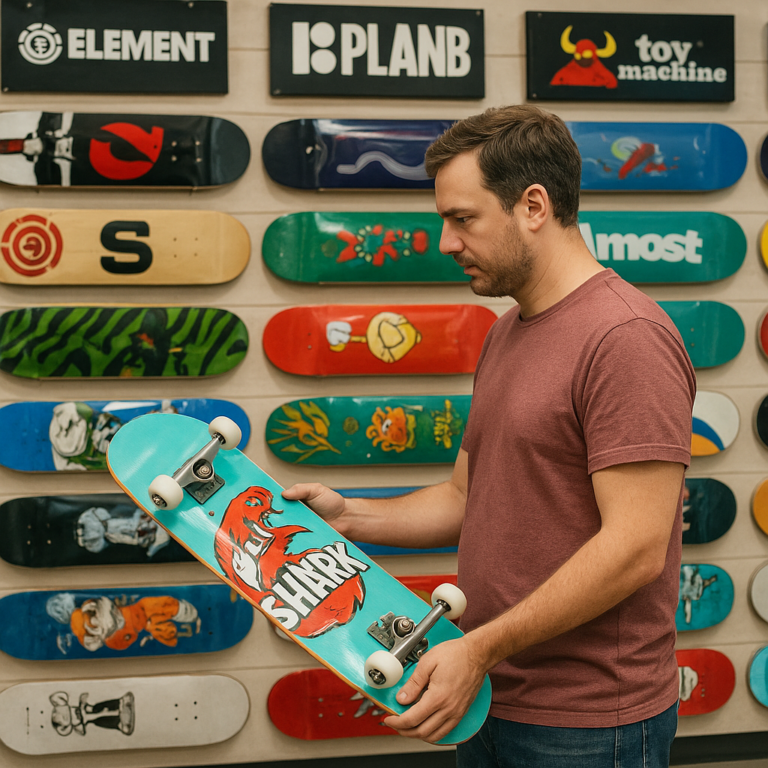
| Local skate shop | Staff can help with sizing, fit, assembly, and local terrain; you may be able to stand on boards | Selection depends on the shop’s stock |
| Skate-focused online retailer | Broad product selection and detailed categories | You can’t physically test the deck before buying |
| Brand’s official store | Direct product information and current model details | May offer fewer comparisons across brands |
| Big-box retailer | Convenient and accessible | Product specifications and component quality can vary; inspect carefully |
The featured video recommends local skate shops for personalized advice and a better chance of finding quality equipment. We share that recommendation, especially for a first board. A good shop can tell you whether a deck feels too narrow, help match trucks, and answer questions without sending you into a 17-tab research spiral.
How to evaluate a skateboard listing online
Before you buy, check that the listing shows:
- Deck width and length.
- Board type and intended use.
- Wheel size and, if provided, durometer.
- Truck information and compatible deck width.
- Whether grip tape, bearings, and hardware are included.
- Seller contact details and return or warranty terms.
Look at reviews for specific riding feedback, not just star ratings. Useful reviews mention the rider’s experience, where they rode, what they liked, and what failed. Be cautious about reviews that offer no detail or appear to describe a different product.
New vs. used skateboards: what to inspect
A used board can be a reasonable option if it’s structurally sound and the components are in good condition. Inspect the deck for cracks or separation, check that trucks aren’t bent, spin each wheel, and make sure the hardware is present.
Pass on a board with a cracked deck, significant delamination, badly bent trucks, or wheels that bind. Worn grip tape or scratched graphics are cosmetic; structural damage is not.
💵 How Much Should You Spend on a Skateboard?
We won’t pretend there’s one magic budget. The Longboards USA guide suggests a beginner-oriented range, but the right spend depends on the board type, component quality, brand, and what’s included. Compare what you’re getting rather than chasing a number.
A sensible shopping approach:
- For a first board, compare complete skateboards from reputable skate brands and established skate retailers.
- Check whether the board includes functional trucks, wheels, bearings, grip tape, and hardware.
- Consider whether the board is suitable for your riding surface.
- Leave room in your plan for a helmet and other safety gear.
- Avoid paying extra for decorative features if basic setup quality is unclear.
A very cheap board can cost you in frustration if it doesn’t roll or steer properly. A more expensive board isn’t automatically better for you. The best value is a setup you can ride safely and confidently.
🪖 Skateboard Safety Gear and First-Ride Checks
Wear a helmet that fits securely and is designed for skateboarding. The U.S. Consumer Product Safety Commission provides helmet safety guidance, and CDC HEADS UP offers information on concussion awareness and prevention. For skateboard-specific gear, look for a helmet meeting an applicable skateboarding standard, such as ASTM F1492, and check the product label.
Consider:
- ✅ Properly fitted helmet.
- ✅ Wrist guards while learning, if they fit securely and suit your activity.
- ✅ Knee and elbow pads for beginners and park sessions.
- ✅ Closed-toe shoes with a sole that gives you a dependable feel on the grip tape.
Before rolling, check the board’s bolts, wheel clearance, and bearings. Start on level ground away from traffic, pedestrians, and steep slopes. We know helmets aren’t the most exciting part of a setup, but neither is meeting the pavement with your forehead.
❌ Common Skateboard Buying Mistakes to Avoid
- Buying by graphic alone. A great graphic can’t fix a setup that doesn’t fit your riding.
- Assuming every complete is high quality. Check the brand, components, specifications, and seller.
- Choosing a board by height alone. Deck width, shoe size, stance, and comfort all matter.
- Ignoring your riding surface. Small, hard wheels may be uncomfortable on rough pavement.
- Buying parts without checking fit. Deck, truck, wheel, and hardware compatibility matters.
- Treating ABEC as a skateboard speed score. It doesn’t capture how a bearing performs under all skateboarding conditions.
- Riding a damaged or poorly assembled board. Inspect it before the first session.
- Skipping safety gear. A helmet and appropriate pads are part of a responsible setup.
- Buying a highly specialized board before you know your preferences. Start with the riding you’ll actually do, then refine your setup later.
One recommendation does vary by source: some guides give a specific “ideal” deck width or beginner price range, while video advice favors boards around 8 inches and above. These are useful starting points, not universal rules. Trust the measurable fit and component specifications, then test how the board feels for your body, terrain, and goals.
🔧 Skateboard Maintenance: Keep Your New Board Rolling
A little maintenance keeps a new board feeling predictable.
- Keep the board dry. Water can damage the deck and contribute to bearing corrosion.
- Check bolts and nuts regularly. Make sure hardware stays secure.
- Remove dirt from wheels and bearings. Follow the bearing maker’s cleaning instructions; don’t soak parts unless the manufacturer says it’s appropriate.
- Check for wheelbite. If wheels contact the deck during turns, review truck tightness, wheel size, and setup clearance.
- Inspect the deck. Look for cracks, soft spots, or delamination.
- Replace worn parts when needed. A shop can help identify whether a wheel, bearing, truck component, or deck needs attention.
Keep bearings dry, as the featured video advises, and avoid riding through puddles. For more equipment coverage, explore Skateboard Gear and our Skateboard Brand Guides.